Free Methodists and the Prayer Book Lectionary
(By the Revd. Joel Webb, the pastor of a Free Methodist Church in Croswell, Michigan, describing his introduction of the traditional one-year BCP lectionary into his church’s worship.)
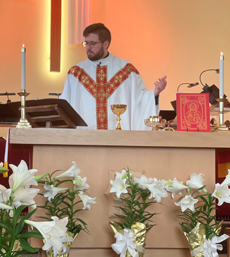 On January 19, 2025, I began my first Sunday as pastor at Croswell Free Methodist Church. This historic congregation, the first Christian worshipping community in Croswell, predating the city’s incorporation, has a storied past and a prominent physical presence in the downtown. Known locally simply as “the Methodist Church”, it carries a deep legacy shaped by both continuity and recent change.
In the wake of denominational shifts within the United Methodist Church regarding teachings on morality and sexuality, this congregation made the uncommon decision among nearby Methodist churches to affiliate with the Free Methodist Church rather than the newly formed Global Methodist Church. Following that transition and the retirement of their lay pastor, and just months before my own ordination, I was appointed to serve.
The Free Methodist Church itself was founded in 1860 in Pekin, New York, under the leadership of B. T. Roberts and others who were expelled from the Methodist Episcopal Church. Their commitments were: abolition, holiness of life, and a return to a more vital and disciplined Methodism as in its primitive state. What began as a renewal movement has since become a global denomination, with the 95% of its members now outside the United States.
Yet despite this rich heritage within the pan-Wesleyan movement, the modern Free Methodist Church often reflects the broader patterns of American evangelicalism in both theology and worship style. While our official rituals of Baptism and Holy Communion remain, and still bear the liturgical traces of the 1662 Book of Common Prayer, they are often detached from the fuller liturgical and sacramental framework that once sustained Methodist life, especially in praxis.
This raises an important question: how does a Free Methodist congregation come to embrace a more historic, liturgical pattern of worship? In our case, it has been a convergence of history, context, and formation. The congregation’s United Methodist roots meant that a structured liturgy was not entirely foreign. At the same time, my own journey, shaped by a growing engagement with the liturgical and sacramental traditions of the Church, provided both the impetus and the framework for renewal.
I was first introduced to the Book of Common Prayer through Anglican bus-mates during a trip to Israel, an encounter that confirmed a trajectory already forming in my life and ministry. That trajectory deepened through seminary study, particularly in lectionary-based preaching, and through sustained engagement with the Anglican and Wesleyan traditions. John Wesley’s Anglicanism became especially significant for me. As a lifelong priest of the Church of England, Wesley’s spirituality was formed by the rhythms of Scripture and the Book of Common Prayer; Morning and Evening Prayer, frequent Communion, and the ordered life of the Church. Methodism, in its earliest expression, did not abandon these patterns but intensified them. Recovering that vision has become central to both my personal life and pastoral ministry.
When I arrived in Croswell, we began with the Revised Common Lectionary alongside the standard Sunday liturgy from the United Methodist Hymnal. This provided a familiar and accessible starting point. From there, our worship developed in several stages. By Pentecost, we had moved to weekly celebration of Holy Communion and began using the 2019 ACNA lectionary. Shortly thereafter, our liturgy took shape around a slightly adapted form of the Renewed Ancient Text from the 2019 Book of Common Prayer. These changes were received with openness, especially when paired with intentional teaching, including an instructed Eucharist that walked the congregation through the meaning of each element of the service.
In the weeks leading up to Advent 2025, I encountered a series of papers from the Prayer Book Society of Canada (PBSC) commending the traditional one-year lectionary. Compelled by their argument, I began studying the 1662 lectionary more closely, alongside Fr. Melville Scott’s The Harmony of the Collects, Epistles, and Gospels, which offers rich theological commentary on its structure. What became increasingly clear is that the strength of the one-year lectionary lies not simply in its content, but in its repetition. Over time, its fixed cycle forms patterns, grooves, in the hearts and minds of a congregation. Scripture is not only read but remembered; not only encountered, but internalized. For this reason, we transitioned to the 1662 one-year lectionary at the start of the liturgical year in Advent: purchasing a copy of the lectionary book, conformed to the collects of the ACNA, and even creating our own Gospel book with the readings in the translation our church uses (NIV). While we are still in the early stages of this practice, even now in our first year, there is a growing sense of coherence and depth in our common life of worship.
Our hope is that, over the course of years, this steady rhythm of Word and Table will form us more fully as a Eucharistic people, rooted in Scripture, shaped by prayer, and grounded in the historic life of the Church. In this way, what began as a local pastoral transition may, by God’s grace, become part of a wider recovery of Wesleyan liturgical and sacramental identity.
More broadly, it is my hope that this kind of renewal might contribute, even in a small way, to a wider recovery of Methodism’s Anglican inheritance, not as an exercise in nostalgia, but as a living resource for theological clarity, sacramental depth, and ordered worship. The genius of early Methodism was not in departing from this heritage, but in enlivening it for the sake of evangelism and holy living. Through my involvement in the Free Methodist Liturgical Network, I am encouraged that this recovery is not isolated, but part of a growing conversation and shared work, seeking to see this inheritance once again take its rightful place in both our theology and our practice.