An Evangelical Christian’s Journey
to Prayer Book Anglicanism
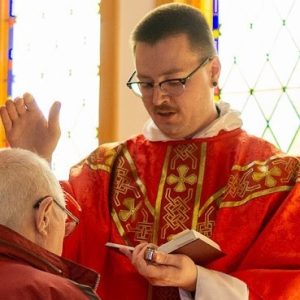
(By the Ven. Brody Albers, Archdeacon of Prince Albert in the Diocese of Saskatchewan. He was a PBSC bursary recipient during the three years of his studies at theological college; he has been a long-time supporter of the Society and is now a member of our National Council.)
When I first went to Briercrest College and Seminary in southern Saskatchewan in 2013, I was on the hunt for a church to attend during my time there. After several Sundays of hopping around churches both in Caronport where the College is located and in nearby Moose Jaw, a friend invited me to St. Aidan’s Anglican Church for worship one Sunday. Though I was “church-shopping” at the time, I did not consider the Anglican church a viable option. What I had heard of Anglicans during my time in the Evangelical Protestant church of my youth was not favourable: it appeared that they were something like the Roman Catholics, and we were all deeply suspicious of the Catholics. I thought that I would take up my friend’s invitation, view the spectacle, and continue on my way the next Sunday looking for my perfect church. I have been an Anglican ever since.
It was during my time at St. Aidan’s that I encountered the Prayer Book tradition, though it was not what was used on Sundays. However, even though, like many parishes, St. Aidan’s employed the Book of Alternative Services on Sundays, the underlying spirituality was thoroughly Prayer Book. Daily offices were read from the BCP, and when I joined the vestry at the parish, our vestry retreat worship was from the Prayer Book. During those years I was also involved in a daily office “plant” of sorts at Briercrest College, where the BCP office of Evening Prayer was made available on campus for
students of Briercrest and other interested people a couple of times throughout the week. It was in leading this initiative that I first experienced Prayer Book spirituality in a robust, regular way, and through which I first felt a clear call to holy orders in the Anglican Church myself.
What I have come to appreciate deeply about the Book of Common Prayer as an Evangelical Protestant turned Anglican is the BCP’s steadfast insistence on the Holy Scriptures as the ultimate authority for our faith, worship, and practice. As I have studied the scriptures more and more, I have come to recognize this: what has been passed on to us in the Prayer Book tradition is a thoroughly biblical pattern of worship, prayer, and living. The English reformers, Cranmer in particular, were deeply and acutely attuned to the scriptures in a way that modern Christians have not been able to fully appreciate in our contemporary society which too often likes to claim that we know better than our forebears.
This is reflected regularly in my ministry as a parish priest. When I come to the pulpit, my aim is to bring the scriptures to the pulpit and proclaim what they say. Of course, there is always the preacher’s own interpretation at work and that cannot be entirely avoided, but as much as possible I see it as the task of the preacher to let the text say what the text wants to say. As I turn to the scriptures and seek to bring out their wisdom for a new generation, I have often found that the Prayer Book has beaten me to the task.
For example, on Ash Wednesday I wondered what to say to my congregation about fasting. How does one obediently follow the scriptural pattern of fasting given to us in the Old and New Testaments? The Prayer Book, it turns out, has provided what I believe to be a deeply biblical pattern in its table of Fasting, Abstinence and Days of Solemn Prayer found on page xiii. These instructions for fasting that are set out for us in the Prayer Book tradition neither fall prey to the severity of the late Middle Ages that the reformers rightly railed against, or the laxity of our own time that simply cannot be supported by the scriptural data. The BCP as a rule always seeks to strike a biblical balance in matters of faith, worship, and practice. Is it a perfect book? By no means! But it does a remarkably good job at striking that balance and I find it a much better guide to living that balance than my own frail reason.
Another great example of this principle is the Anointing of the Sick which is found beginning on page 585. The service opens with the lesson from James 5 in which St. James instructs those who are sick to call the elders of the church “and let them pray over him, anointing him with oil in the name of the Lord”. Many people miss the rubric which says, “Where possible, it is desirable that more than one Priest should take part in the administration.” Unfortunately, in a many places in the Anglican Church of Canada having “more than one Priest” is often not possible, but it shows that the scripture lesson from James 5 is being taken seriously even as the Prayer Book outlines the practice.
The point is that for those who are serious about sola scriptura and want to take what the Bible says seriously, it is hard to find a better system of worship, prayer, and practice than the Book of Common Prayer. What is a worthwhile tradition? The BCP looks to the Bible to answer that question. What is worthwhile practice? Again, the BCP does the same; it looks to the Bible to answer every question about faith, morals, and practice.
I am so thankful for the work of the Prayer Book Society in steadfastly promoting the understanding and use of the BCP in our Anglican Church of Canada. After all, I have heard since I became an Anglican the phrase lex orandi, lex credendi – meaning “the law of prayer is the law of belief”, that is to say what we pray is what we believe. It is no coincidence, I think, that as we have moved away from the Prayer Book in almost every Anglican parish in this vast country, the consequence seems to be less alignment of our church with the plain meaning of scripture. If we are to be a church which is faithful to the Scriptures, we need to be a church which not only prays the words of Scripture but prays and lives scripturally as I’ve described; and the PBSC is doing its part to ensure that this inheritance is not lost for the next generation of Christians in the Anglican Church of Canada.